Jon Bond

Small Island, Big Ideas


  • A Busy Week in the Chamber: What the States Debated and Why It Matters

    A Busy Week in the Chamber: What the States Debated and Why It Matters

    The States of Deliberation sat across two days last week – a special meeting on Tuesday to debate the 2025 Group Accounts, followed by an ordinary sitting on Wednesday with a packed agenda. Taken together, the sessions gave a clear picture of where the island’s finances actually stand, committed serious capital to long-deferred infrastructure problems, and quietly made some decisions about planning and employment law that will matter to businesses and residents for years to come.

    Here’s a rundown of what happened, and what I think it means.

    Tuesday 23 June: The 2025 Accounts — Surplus, Deficit, or Both?

    The special sitting existed for a single purpose: to debate the 2025 Group Consolidated Financial Statements. But the headline number, a £45 million operating surplus, needs unpacking, because on its own it is genuinely misleading.

    Policy & Resources President Deputy Lindsay de Sausmarez has been admirably clear about this. The surplus is real, but it was driven significantly by one-off factors: around £34 million came from one-off banking sector tax adjustments, investment valuations jumped by more than £100 million (but those are paper gains, not cash income), and Pillar II global minimum tax on large multinationals contributed roughly £39 million to a revised group surplus figure of over £100 million for the year. Strip out the one-offs, and the picture is materially weaker.

    The structural deficit – the ongoing gap between what the island routinely collects in tax and what it routinely spends on services, has narrowed slightly from £58 million to around £50 million. That is progress, but it remains a very large number for an island of this size, and it is the number that actually matters for the long-term fiscal position. As Deputy de Sausmarez put it, two things can be true at the same time: a good year on paper, and a continuing structural problem underneath.

    The Scrutiny Management Committee, led by economist Deputy Andy Sloan, added a pointed note ahead of the debate: their concern was not whether the accounts are technically correct, but whether they are sufficiently accessible and understandable to those for whom they are ultimately intended. That is a fair challenge. If the President of the Scrutiny Committee publicly says he struggles to understand them, there is a real question about whether the accounts serve their democratic purpose. States accounts have to be produced to IPSAS standards (International Public Sector Accounting Standards), and those standards are rigorous, but rigour and accessibility are not the same thing.

    A few other numbers worth noting from the 2025 accounts: income tax revenues rose by £110 million year on year, social security contributions increased by £16 million on the back of higher rates and rising wages, and document duty on property also picked up. On the expenditure side, the Aurigny operating loss came in at £6.3 million and the airport PFAS clean-up (more on that below) featured as a significant capital item.

    The broader context here matters enormously. The States is heading into a July debate on tax reform, the most consequential fiscal decision of this parliamentary term, with accounts that show a good year and an uncomfortable underlying reality simultaneously. The risk is that the headline surplus gets used to argue that urgency has passed. It hasn’t. The structural deficit doesn’t fix itself, Pillar II receipts are likely to decline over time as international tax rules evolve, and 75% of Guernsey’s revenues coming from personal income tax and social security contributions from a working-age population on an ageing island is a fragile base. The accounts are the starting point for that conversation, not the end of it.

    Wednesday 24 June: Infrastructure, Planning, and the Legislative Backlog

    The ordinary sitting on Wednesday carried a broad agenda. Here are the items worth paying attention to.

    PFAS at the Airport: Committing £16.5 Million to Clean Up an Old Mess

    The most significant capital decision of the week, and arguably the most significant infrastructure vote of the year so far outside the hospital, was the proposition to authorise up to £16.54 million to excavate, transport, and treat approximately 15,000 to 16,000 tonnes of PFOS-contaminated soil stored at Guernsey Airport.

    PFOS (perfluorooctane sulphonate) is a “forever chemical” – it does not break down in the environment and accumulates in the body. It got into the airport site through decades of use in firefighting foam from the 1970s until the early 2000s. The contaminated soil was excavated and stored in geotextile-lined bunds during the airport rehabilitation works in 2012, because at the time there were limited treatment options available. That bund is now failing. Regular monitoring has confirmed it is beginning to deteriorate, and the chemical levels in the soil are rising, presenting a direct risk to groundwater near the site and ultimately to St Saviour’s Reservoir.

    The preferred solution, approved by the States’ Trading Supervisory Board (STSB) after assessment of multiple options, is to excavate the soil, ship it to the UK, and treat it through a soil washing process. The contamination is then extracted from the wash water through carbon filtration and destroyed by heat treatment. Containing it on-island was deemed inadequate by the local waste regulator, Guernsey Water. Building an on-island treatment facility was ruled out as technically and logistically unfeasible. Exporting and treating the soil is the only route that actually solves the problem.

    The cost is striking. A provisional estimate of £3 million when the soil was first stored has become £16.5 million. That escalation reflects both the volume of contaminated material and the complexity of treatment. An amendment tabled by Deputies Adrian Gabriel and Andy Cameron added an interesting dimension, rather than simply approving the clean-up, they asked STSB and P&R to explore what the freed-up bund land could be used for once the soil is gone, with options including a multimodal transport hub integrating bus services, cycling infrastructure, rideshare and pedestrian access at the airport. Whether that ambition survives the inevitable budget pressures is another question, but the instinct to use a remediation project to think forward about land use is sound.

    This is a hard vote for some Deputies, purely on cost grounds. But the alternative is to leave a deteriorating hazard in place, risking far greater remediation costs and reputational damage to Guernsey’s environmental standards. Deferred problems compound. The States tried to recover costs from 3M, the manufacturer of the foam, however that action ultimately settled unfavourably, with Guernsey liable for £1.4 million of 3M’s legal costs plus its own £6.6 million in legal fees. The island has been carrying this problem for a long time. Approving the clean-up is the right call, even at this price.

    QEII Marina Gates: £10.7 Million for Critical Infrastructure

    The STSB also brought forward a proposition to authorise up to £10.7 million for the replacement of the QEII Marina gates and associated infrastructure, funded through a split of a £5.35 million grant from the General Revenue Reserve and a £5.35 million interest-bearing loan.

    The gates are 40 years old. The STSB is unambiguous: without action, they will continue to deteriorate and there is a high probability of failure beyond repair. The QEII is the island’s largest marina with over 700 berths. Failure would not just inconvenience berth holders — it would represent a serious financial risk to Guernsey Ports’ balance sheet and, frankly, a reputational hit to the island’s profile as a marine and leisure destination. Guernsey Ports cannot fund this from its own resources without significantly increasing user fees or sacrificing other investment priorities.

    The proposition asks the States to authorise the funding envelope, with the actual release of funds subject to P&R approval of a Full Business Case. That’s appropriate governance for a £10 million-plus commitment. If approved, construction could be complete by end of 2027.

    This is exactly the kind of capital maintenance that tends to get deferred during periods of fiscal pressure and then becomes an emergency. Better to act now than to explain to berth holders why the island’s premier marina is out of service.

    Island Development Plan: Extending to 2030

    The IDP, Guernsey’s foundational planning document, dates from 2016. That makes it a decade old at a time when planning backlogs, affordable housing pressure, and evolving land use needs have all moved substantially. The proposition before the States was simply to extend its validity until 31 December 2030, or until a replacement is formally adopted.

    This is uncontroversial as a procedural matter – you can’t let the planning framework lapse while a full review is underway – but it is worth flagging that a 10-year-old IDP is a genuinely blunt instrument in a housing market that needs finer calibration. The focused review currently underway, which covered affordable housing site allocation and other specific policy areas, went through a public hearing earlier in 2026 and is with the Development and Planning Authority. An Autumn debate on those changes is expected. But the broader IDP review, replacing the whole plan, remains work in progress.

    For businesses and developers, the extension provides certainty that the existing rules remain operative. That matters for planning applications and investment decisions.

    Prioritisation of Legislative Drafting and an Amendment That Reveals the Real Tension

    One of the more substantive debates of the day was the proposition to approve a schedule of prioritised legislative drafting, essentially, which laws get written and in what order. P&R brought this forward; Deputies Lindsay de Sausmarez and Adrian Gabriel put in an amendment.

    Legislative drafting is a genuine bottleneck in Guernsey’s system. The island’s legislative counsel resource is finite, and there is always more demand than capacity. Prioritising the drafting schedule is therefore a meaningful governance decision — whatever goes to the bottom of the list does not get done, at least not soon.

    The amendment by de Sausmarez and Gabriel is interesting for what it signals: two Deputies prepared to use the amendment mechanism to push for different priorities within the drafting queue. The July meeting is expected to be heavy with tax reform-related legislation; getting the drafting priorities right now is pre-work for that. Worth watching how this plays out in votes.

    Extending Employment Tribunal Jurisdiction to Alderney

    A straightforward but quietly significant proposition: extending the scope of the Employment and Discrimination Tribunal (Guernsey) Ordinance to include Alderney, specifically to allow the Tribunal to hear minimum wage cases arising on the sister island. Currently, workers in Alderney who have minimum wage disputes have no clear tribunal route.

    This is the kind of Bailiwick coherence measure that should not be controversial, and probably won’t be. It brings Alderney workers in line with protections available in Guernsey, which is both fair and logically consistent with the direction of travel on employment rights.

    Education Legislation

    Three education items came through: a commencement ordinance for the Education (Guernsey) (Amendment) Law 2025, a governance boards amendment, and application of education legislation to Alderney. These appear largely procedural, bringing law that has already been debated and approved into effect, and extending it to Alderney. Worth noting the pattern of Alderney items across this sitting: there is a quiet programme of legislative harmonisation underway across the Bailiwick.

    The Bigger Picture

    Two themes run through this week’s business.

    The first is infrastructure deferred. The PFAS clean-up and the QEII Marina gates are both examples of a pattern: problems that were identified, partially managed, and then left to compound while fiscal conditions made capital commitments difficult. The bill is now larger in both cases than it would have been with earlier action. That is the real cost of a structural deficit, not just the annual shortfall, but the tendency to defer maintenance and investment until deferral is no longer an option.

    The second is the pressure building for July. The 2025 accounts, the P&R general update statement on Wednesday, and the legislative drafting prioritisation all point in the same direction. The July States meeting, where tax reform proposals are expected to be debated, is shaping up to be the most consequential sitting of this parliamentary term. The decisions taken this week are in many ways the setup for that debate: the accounts give context for the fiscal case, the capital commitments give a sense of the investment needs the island cannot avoid, and the legislative queue sets the drafting priorities.

    If you want to understand where Guernsey’s public finances are, and where the real decisions are being made, July is the meeting to watch.

    Jon Bond is Founder and CEO of Evans Bond Limited, an accountancy and advisory practice in Guernsey, and principal of Melius Consulting Limited – a business consultancy. He is also a non-executive chairman of both CI Co-op and Sark Shipping. The views expressed here are his own.

  • Guernsey’s Tax Reform 2026: What It Actually Says, and What It Doesn’t

    Guernsey’s Tax Reform 2026: What It Actually Says, and What It Doesn’t

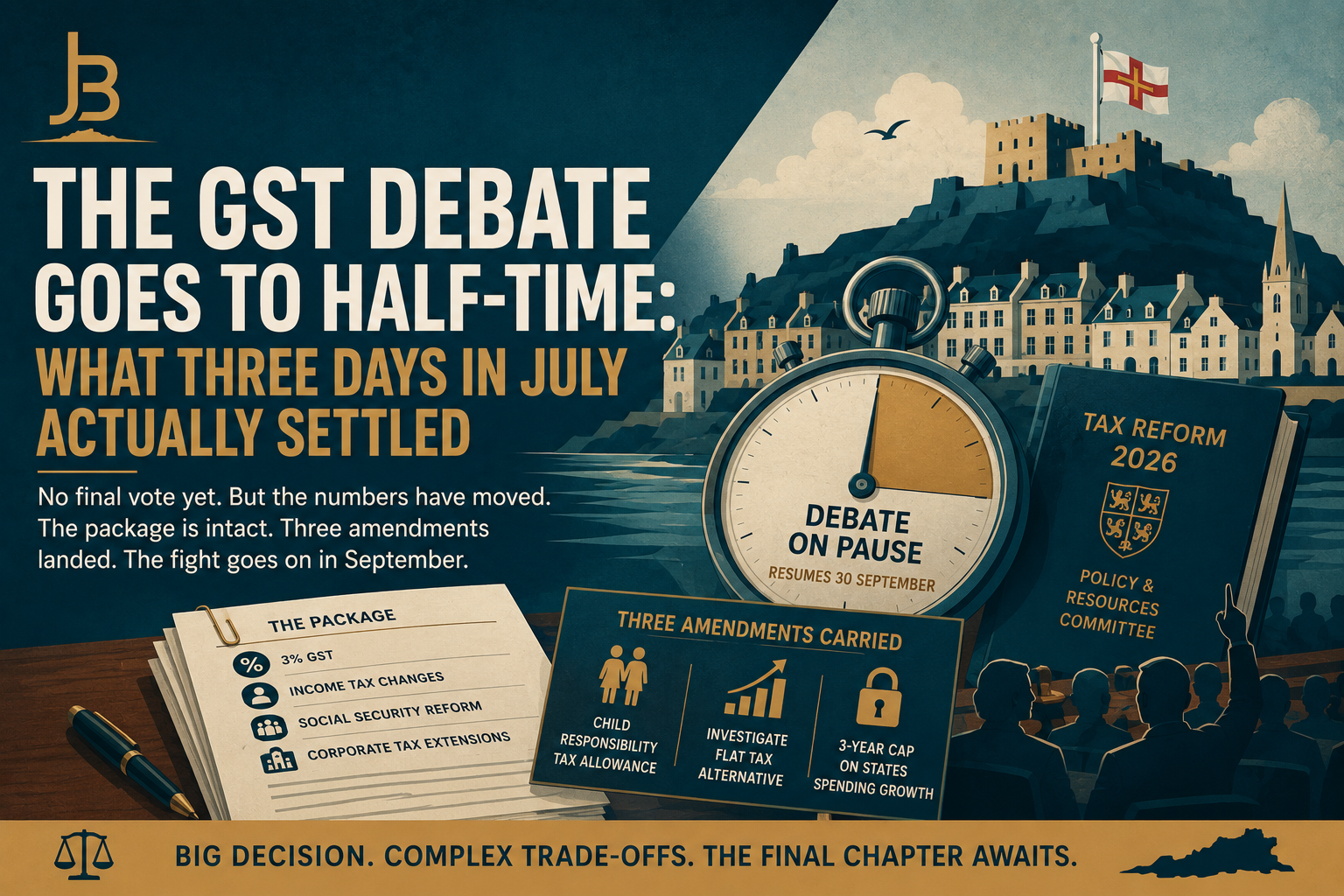
    After years of Green Papers, Billets, rejected amendments, and deferred decisions, the States of Deliberation are again being asked to vote on a substantive, costed tax reform package. The Policy Letter published this week is the culmination of over a decade of deliberation, and whatever you think of the conclusions, it is a serious piece of work that deserves a serious read.

    So let me try to give you that.

    The Problem They’re Trying to Solve

    The starting point is not in dispute. Guernsey has been running a structural deficit for several years — spending has consistently outpaced revenue, and reserves have been used to paper over the gap. The 2026 Budget estimate puts the structural deficit at around £77 million a year, and that figure is calculated after factoring in the expected £40 million annual uplift from Pillar 2.

    That £77 million is not a rounding error. It is not going to be fixed by efficiency savings alone. The General Revenue Reserve, the buffer that has been absorbing shortfalls, is projected to be exhausted by 2031 on the current trajectory.

    The demographic picture makes this worse. The working age population is shrinking relative to the overall population. Three quarters of all States revenue comes from individuals, personal income tax and social security contributions. That tax base is narrowing as it ages, just as demand for health, long-term care and pension expenditure accelerates. The Policy Letter is honest about this: these pressures will continue to grow for several more decades.

    This is the genuine context for what follows. You can disagree with the solution without ignoring the underlying problem.

    What the Package Actually Contains

    The proposed package has five main components. Here is what each actually does.

    1. Income Tax: Lower Rate, Lower Threshold

    The headline change is a reduction in the basic rate of personal income tax from 20% to 15%, applied to income up to £28,000. Income above that threshold continues at 20%. The personal allowance also rises by £600.

    This sounds like a tax cut, and for most earners it is. But the design matters. The 15% band cuts off at £28,000 which is below the median full-time earnings figure in Guernsey. The policy is deliberately redistributive: lower and middle earners gain more than higher earners in percentage terms.

    The net revenue impact is a reduction of £28 million. The income tax reform is not a revenue-raiser, it is the redistributive counterweight to GST.

    2. Social Security: A Restructured System

    The social security changes are more complex and have been significantly moderated from the November 2024 package. Key changes include:

    • A new social security allowance for employed and self-employed contributors, set at £11,122 (currently the allowance for non-employed contributors), with a longer-term ambition to align this with the income tax personal allowance
    • Employer contributions increasing to 7.6% by 2029 (phased from the current 7.1%), payable up to the Upper Earnings Limit of £196,560
    • A new additional rate of 2.5% for employers and self-employed individuals on earnings between the Upper Earnings Limit and £300,000
    • Employee contributions rising to 8.5% from 2028; self-employed to 14.5%; non-employed under pension age to 8.5%; non-employed over pension age to 4%

    One significant change from November 2024: the proposal to apply social security contributions to all income (including rental income) has been deferred. The Policy Letter is candid about why: concern that this would push landlords out of the market, compounding Guernsey’s already serious housing supply problem.

    The net revenue impact of the social security changes is a gain of £2 million.

    3. Transport: Fuel Duty Down, Annual Vehicle Tax Up

    This is a package of changes rather than a single measure. Fuel duty drops by 25%, broadly bringing Guernsey into line with Jersey, an estimated saving of £130–£140 per vehicle per year for private motorists.

    In exchange, a new annual vehicle tax is introduced, covering petrol, diesel, hybrid and electric vehicles, based on weight and emissions. The range is £25 to £280 for private vehicles, with a median charge of around £132.

    A surcharge is also added to first registration duty for private vehicles valued over £50,000 (starting at £2,500).

    The net revenue gain from transport changes is £7 million. The fuel duty cut is the headline that will get the press coverage; the annual vehicle tax is the structural change that matters for the long term, particularly as electrification reduces fuel duty receipts over time.

    4. GST: 3%, From 2028

    This is the most controversial element, and the one that has dominated debate for years. The proposal is a Goods and Services Tax at 3%, to be introduced from 2028.

    This is a reduction from the 5% that was agreed in November 2024, driven by concern about the inflationary impact. At 3%, the modelling suggests a one-off increase in RPIX of around 1.9% at introduction — down from 3.2% under the previous 5% proposal.

    The GST package includes:

    • Uprating of the States Pension, income support and other benefits to cover the increased cost of living, with those increases introduced ahead of the GST
    • An Essential Costs Relief Payment for those on lower incomes not in receipt of income support
    • An International Services Entities (ISE) scheme, mirroring Jersey’s, allowing finance businesses with international clients to pay a fee for an End User Relief Certificate rather than filing full GST returns. Expected to raise £10–12 million annually
    • A commitment not to increase the GST rate before the 2030 assurance review

    The net revenue gain from consumption tax measures is £55 million, the dominant revenue line in the package.

    A two-thirds majority requirement to increase the GST rate in future will also be introduced, providing a structural protection against rate creep.

    5. Corporate Tax: Modest Adjustments Only

    The headline finding from the Tax Review Sub-Committee, chaired by Deputy Charles Parkinson and including three international tax experts, is that fundamental corporate tax reform is not recommended at this time.

    The Sub-Committee considered five options, including a move to a territorial tax regime and a shift from Zero-10 to Zero-15. Both were rejected. A territorial regime would trigger a full review by the EU Code Group, take 12–18 months to resolve, and carry significant risk of business relocation. Moving unilaterally to Zero-15 was modelled to produce minimal net revenue gain once behavioural responses are factored in.

    What is recommended is a set of targeted adjustments:

    • Extending the 10% intermediate rate to apply to the full profits of regulated businesses (not just the regulated activity), aligning with Jersey’s approach (estimated yield: £0.5 million)
    • Extending the 10% rate to prescribed businesses — accountants, legal firms, estate agents registered with the GFSC (estimated yield: up to £2 million)
    • Modest increases to Guernsey Registry fees (estimated yield: ~£0.5 million at RPIX +5%)
    • Further extension to construction and retail deferred until 2030 at earliest

    The net corporate tax gain in the package is £6 million.

    The Sub-Committee also recommends that P&R opens discussions with Jersey and the Isle of Man about a coordinated move to Zero-15 after their General Elections this year — an interesting recommendation that could be significant if picked up.

    The Numbers in Total

    MeasureNet Revenue Impact
    Income tax changes-£28m
    Social security changes+£2m
    Transport taxes+£7m
    GST + ISE scheme+£55m
    Corporate tax adjustments+£6m
    Spending efficiency savings+£20m
    Total~£62m

    Against a structural deficit modelled at £77 million, this package does not fully close the gap. The Policy Letter acknowledges this. That is precisely why the assurance review in 2030 matters, and why the commitment not to raise GST before that review carries real weight.

    What This Package Is, and What It Isn’t

    The political debate will focus on GST. That is understandable as it is the largest single revenue line, and it affects everyone. But framing this as simply “introducing a tax on food and goods” misses the architecture of the package.

    The income tax reduction to 15% is not an afterthought. For a single earner on £28,000, the saving on income tax alone exceeds the estimated annual cost of GST on their consumption. The benefit and pension uprating is front-loaded, it happens before GST is introduced, not after. The Essential Costs Relief Payment is targeted at those not already captured by income support.

    The distributional analysis in the Policy Letter shows that lower and middle income households are, on average, expected to be better off under the full package than they are now. Higher income households are expected to be modestly worse off. That is a deliberate policy choice.

    Whether you accept that analysis depends on whether you trust the modelling, the mitigations, and the political commitment to hold the rate at 3%. Those are legitimate questions.

    What I Think

    The structural deficit is real. The demographic challenge is real. The reserves position is serious. Anyone who believes Guernsey can grow its way out of this problem without broadening the tax base is not engaging with the numbers.

    The balance struck here, lower income tax rates for lower earners, a modest consumption tax, restructured social security, and restrained corporate tax changes, is a considered one. It is not the package I would have designed from scratch, and there are elements I would push back on. But it is a serious response to a serious problem, with a genuine attempt at a progressive tax approach.

    The question the States must now answer is whether they agree. After twelve years of review, the question is no longer whether to act, it is whether this is the right way to act.

    I’ll be watching the debate closely.

    Jon Bond is Founder and CEO of Evans Bond Limited, an accountancy and advisory practice in Guernsey, and principal of Melius Consulting Limited – a business consultancy. He is also a non-executive chairman of CI Co-op and NED at Sark Shipping. The views expressed here are his own.

  • Jersey Voted. What Did It Say?

    Jersey Voted. What Did It Say?

    The results are in from Sunday’s Jersey election and they contain some genuine surprises, a political giant lost his seat, an outsider topped the poll, Ihe hospital contract was finally signed, and the case for party politics just got harder to make. Here’s what it means, viewed from across the water.

    In my pre-election post last week I said Jersey’s 2026 election would be a test of whether the electorate wanted something genuinely different, or whether familiarity and experience would win out over fresh voices. As it turns out, it was a bit of both, but the headline story is the one nobody predicted: Reform Jersey’s leader Sam Mézec, the serving Housing Minister and arguably the most prominent progressive voice in island politics, has lost his seat.

    That is not a small thing. Let’s work through what happened, what the results mean, and what signals, if any, they send to the new States Assembly.

    The Results at a Glance

    15,859VOTES FOR TOP SENATOR HELEN MILES

    9,374MÉZEC VOTES — 2,197 SHORT OF 9TH PLACE

    £710mHOSPITAL CONTRACT SIGNED 2 DAYS BEFORE ELECTION

    18AGE OF YOUNGEST ELECTED MEMBER, GABRIEL RAIMONDO

    The Senatorial Ballot — Full Results

    Jersey voters cast island-wide votes for nine Senators. With 17 candidates standing, the margin between those who made it and those who didn’t tells its own story.

    Senatorial Votes

    Five Things the Results Tell Us

    1. Experience, broadly defined, won the Senate

    Look at the nine elected Senators and a pattern emerges. Helen Miles topped the poll with nearly 16,000 votes – a remarkable result for someone who, four years ago, was a first-time Deputy for St Brelade. But her result reflects experience of a certain kind: 30 years in public service, a high-profile ministerial term, and then a credible stint as opposition scrutineer when the government changed direction. She wasn’t the establishment candidate. She was the candidate who’d seen both sides of government and handled both well.

    Ian Gorst comes second – the most internationally experienced politician in Jersey, and someone whose vote share in the rural parishes was consistently the highest throughout the night. Lyndon Farnham third, the sitting Chief Minister, seeking his mandate. Elaine Millar fourth, the Treasury Minister who made reinstating Senators her signature achievement.

    What this Senate looks like is a broadly centrist, experience-heavy chamber with a bias towards fiscal discipline and financial services credibility. The two notable exceptions: Mary Le Hegarat (9th, first-time Senator) and Serena Kersten Guthrie (5th, entirely new to politics) are both significant in different ways.

    Elected Senators

    2. The Mézec defeat is seismic — but nuanced

    Sam Mézec received 9,374 votes. Mary Le Hegarat, who took the ninth and final seat, received 11,571. That gap of 2,197 votes, across an island-wide ballot, is not a cliff edge – it’s a margin that could have closed with the St Helier results, but did not.

    Mézec has been the most prominent voice for social democratic politics in Jersey for over a decade. As Minister for Housing in the current term, he secured the ‘First Step’ homeownership scheme, new renter protections, and hundreds of new homes. His legislative record is real. The fact that the island-wide electorate chose not to send him to the Senate – while St Helier, where Reform Jersey is strongest, voted for him in large numbers – suggests something specific: his appeal is urban and concentrated, not island-wide.

    There is a harder question lurking here too. Reform Jersey now has 7 seats, down from ten in the last Assembly. Mézec himself is out of the chamber entirely. That is not just a bad night. That is a party facing a structural question about whether its model – a left-leaning progressive party in a conservative-leaning island, is viable at scale.

    Reform Jersey – The Numbers

    In 2022, Reform Jersey held 10 seats in the States Assembly. As of the 2026 results, they are projected to hold between 3 and 5 seats, with St Helier counts still outstanding. Their leader has lost his seat. Their Education Minister (Rob Ward) lost his bid for Constable of St Helier. The party’s Deputy Leader Lyndsay Feltham’s result in St Helier Central is not yet confirmed. This is a significant reduction in their parliamentary presence.

    3. The Kersten Guthrie result is the one to watch

    Serena Kersten Guthrie, former England netball captain, political newcomer, and Value Jersey-aligned candidate, finished fifth – ahead of Tom Binet, Alan MacLean, Mark Boleat, and seven others, with 12,588 votes.

    In my pre-election analysis I flagged her as the most unusual candidate in the field. That unusual quality clearly resonated. What does it mean?

    Partly it’s biographical – a decorated athlete from a recognisable background brings a kind of credibility that professional politicians sometimes lack. Partly it’s the Value Jersey alignment – a loose grouping of candidates united around consumer choice, cheaper everyday costs, and cutting government waste. As parish results were being announced through the night she consistently came second or third.

    Watch this closely: Value Jersey as a movement, not quite a party, more than a leaning, performed well enough across the Deputy elections too (Samantha Gleave topped the poll in St Helier South). If that cohesion persists into the new Assembly, it could constitute a real force: centre-right consumer economics, independent-minded, with populist energy behind it.

    4. The hospital was signed just in time

    Two days before election day, the Government confirmed that the main works contract for the new hospital at Overdale had been signed with Bouygues UK. The project has a budget of £710 million, making it the largest public infrastructure project in Jersey’s history, with delivery targeted before the end of 2028.

    The timing was noted. Health Minister Tom Binet had warned in April that there was “no guarantee” the contract would be signed before the election. It was. Whether that influenced voters is impossible to say with certainty, but Binet finished sixth in the Senatorial poll – comfortably elected, with a vote share that reflects genuine public recognition of his work.

    The new Assembly inherits this project. It will be the defining test of delivery for the incoming government: a £710m construction programme, a contractor whose UK arm has had financial difficulties, and a completion target set in the middle of the next term. The new Senators who promised to hold government to account on delivery will have no shortage of material.

    The Hospital – Key Facts

    Budget: £710 million (States Assembly approved).

    Contractor:Bouygues UK (subsidiary of French construction giant Bouygues Construction — 400+ global healthcare projects).

    Target completion: Before end of 2028.

    Contract signed: 5 June 2026, two days before election day.

    Outgoing minister: Tom Binet, elected Senator — will not be Health Minister by default in new government.

    5. An 18-year-old was elected Deputy

    Gabriel Raimondo, 18 years old, was elected as a Deputy for St Brelade, becoming the youngest member of the States Assembly. He received 1,603 votes, in a constituency also electing experienced candidates Jonathan Renouf (who topped the poll with 2,414 votes) and Reform Jersey’s Monty Tadier.

    This is worth noting for reasons beyond the symbolism. Jersey has a voting age of 16. An 18-year-old Deputy is the logical extension of a political culture that takes youth participation seriously. Whether Raimondo proves effective is a question only time will answer, but his election sends a signal that constituency voters are willing to take a chance on someone whose principal qualification is that he is, himself, a young person with a stake in the decisions being made.

    What the New Assembly Looks Like

    The most significant question now is who becomes Chief Minister. Gorst has publicly said he will put himself forward for External Relations Minister again. Farnham has indicated he wants to continue as Chief Minister. But with Helen Miles topping the poll and Elaine Millar suggesting she would support Miles over competing against her, there is a genuine possibility of a female Chief Minister for the first time in Jersey’s history, if Miles chooses to put herself forward on 19 June.

    The Messages for the New Assembly

    Elections are often said to send messages. Jersey’s 2026 result sends several, and they are not all comfortable ones for the incoming government.

    01 Delivery is the Mandate

    The electorate returned experienced, recognisable politicians. Not radicals. That is a conservative choice — in the literal sense. It is a vote for getting things done, not for changing direction. The new government will be judged on what it delivers, not what it says.

    02 The Cost of Living Cannot Wait

    Value Jersey’s strong showing — from an outside newcomer no less — is a direct signal about affordability. Kersten Guthrie’s fifth place finish is a message: voters want cheaper choices, more competition, less government drag on everyday costs. The new Assembly ignores this at its peril.

    03 The Left have been Pushed to the Margins

    Reform Jersey’s collapse from ten seats to fewer than five is a fundamental shift. There is now very limited organised progressive representation in the Assembly. That may suit the new government; it makes meaningful scrutiny of housing and welfare policy harder.

    04 The Hospital must now be Built

    The contract is signed. The £710m is committed. Bouygues UK is on site. This is no longer a political football — it is a construction project with a deadline. The new Assembly must resist any temptation to relitigate decisions already made and focus on delivery.

    05 GST is on the Agenda

    Multiple losing candidates called for GST to be removed from food. The issue did not disappear; it simply wasn’t reflected in the Senate. A £710m hospital and infrastructure backlog means the fiscal question won’t go away. Jersey will need to have an honest conversation about how it pays for things.

    06 Youth and Diversity are Visible

    An 18-year-old Deputy. The first female Constable of St Helier. The island’s first Senator without a career political background in a generation. These are small steps, but they signal that the electorate is willing to widen the pool — when candidates make the case for themselves.

    The View From Guernsey — What This Means for Us

    I said in my pre-election post that Jersey’s issues are Guernsey’s issues. The results reinforce that. The centrist, experience-favouring outcome; the voter appetite for cost-of-living action; the grinding difficulty of delivering major infrastructure — none of that is peculiar to St Helier.

    There is one result in particular that I think Guernsey should sit with. Sam Mézec — whatever you think of his politics — was the most prominent champion of progressive social policy in the Channel Islands for twelve years. He championed tenant rights, minimum wage rises, housing supply, and public accountability. He has now lost his seat in an island-wide ballot. That is partly about electoral arithmetic. But it is also a reflection of a political culture that is instinctively wary of structural reform, and which tends, when uncertain, to return to the familiar.

    The question for Guernsey is not whether we share that instinct — we almost certainly do — but whether, when our own fiscal pressures force difficult decisions, we have the political infrastructure to navigate them well. An Assembly of independents, all elected on personal platforms, all instinctively cautious about being the one to say the uncomfortable thing, is not automatically well-equipped for that moment.

    Jersey has its new government. The hospital contract is signed. The Chief Minister question will be resolved on 19 June. Whatever happens next, Sunday’s result suggests that the island wants steady hands on the wheel — and will hold them to account for what those hands actually build.

    Jon Bond is Founder and CEO of Evans Bond Limited, an accountancy and advisory practice in Guernsey, and principal of Melius Consulting Limited – a business consultancy. He is also a non-executive chairman of CI Co-op and NED at Sark Shipping. The views expressed here are his own.

    The View From Guernsey — What This Means for Us

    I said in my pre-election post that Jersey’s issues are Guernsey’s issues. The results reinforce that: the centrist, experience-favouring outcome; the voter appetite for cost-of-living action; the grinding difficulty of delivering major infrastructure – none of which is peculiar to St Helier.

    There is one result in particular that I think Guernsey should take note of. Sam Mézec, whatever you think of his politics, was the most prominent champion of progressive social policy in the Channel Islands for twelve years. He championed tenant rights, minimum wage rises, housing supply, and public accountability. He has now lost his seat in an island-wide ballot. That is partly about electoral arithmetic. But it is also a reflection of a political culture that is instinctively wary of structural reform, and which tends, when uncertain, to return to the familiar.

    The question for Guernsey is not whether we share that instinct, we almost certainly do, but whether, when our own fiscal pressures force difficult decisions, we have the political infrastructure to navigate them well. An Assembly of independents, all elected on personal platforms, all instinctively cautious about being the one to say the uncomfortable thing, is not automatically well-equipped for that moment.

    Jersey has its new government. The hospital contract is signed. The Chief Minister question will be resolved on 19 June. Whatever happens next, Sunday’s result suggests that the island wants steady hands on the wheel, and will hold them to account for what those hands actually build.

    Jon Bond is Founder and CEO of Evans Bond Limited, an accountancy and advisory practice in Guernsey, and principal of Melius Consulting Limited – a business consultancy. He is also a non-executive chairman of CI Co-op and NED at Sark Shipping. The views expressed here are his own.