Jon Bond

Small Island, Big Ideas


Category: Small Business

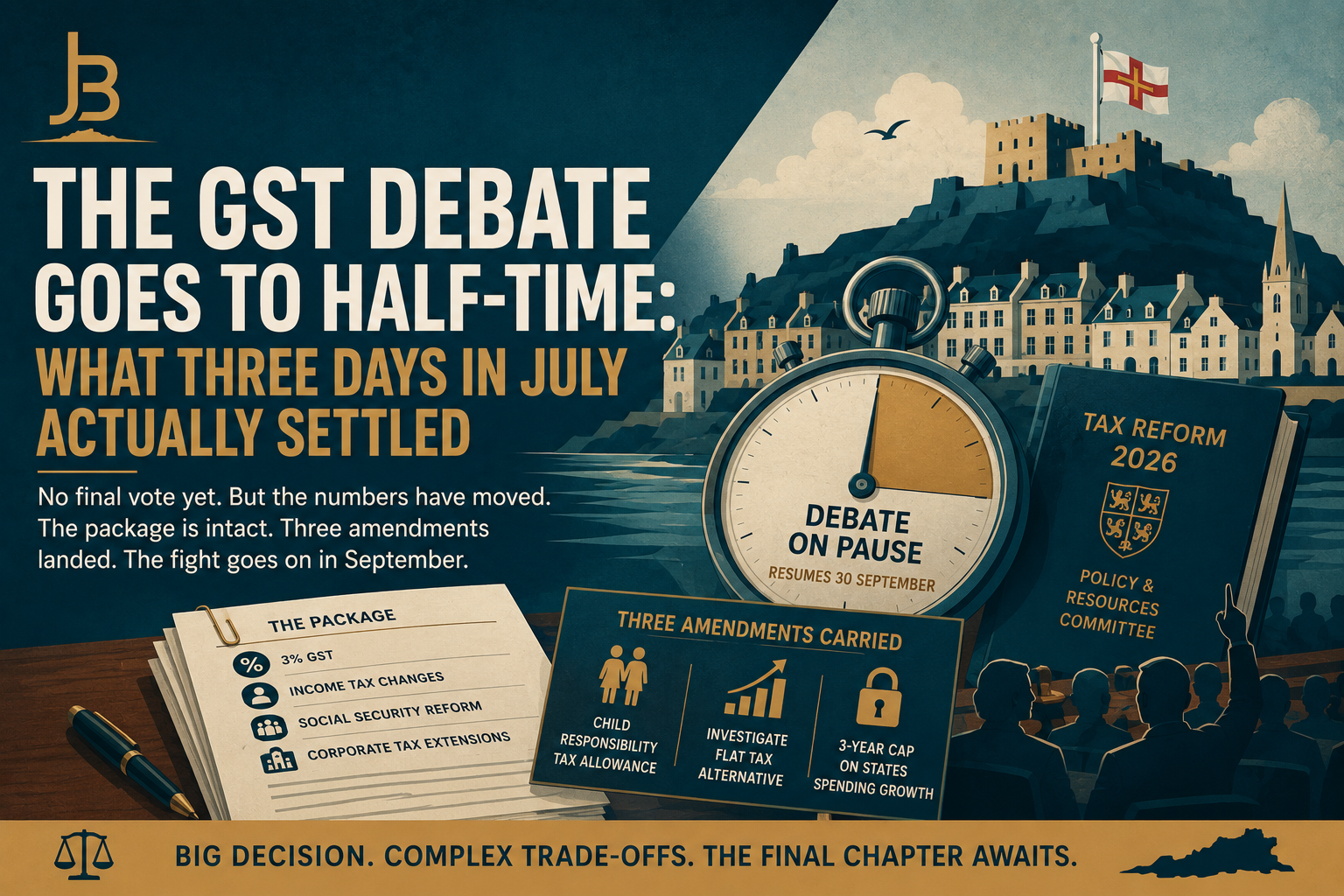
  • The GST Debate Goes to Half-Time: What Three Days in July Actually Settled

    The GST Debate Goes to Half-Time: What Three Days in July Actually Settled

    Guernsey’s biggest tax decision in a generation is now on a summer break. After three days of debate on 15–17 July, the States ran out of road before reaching a final vote on Policy & Resources’ tax reform package — the 3% GST, the accompanying income tax and social security changes, and the corporate tax extensions attached to it. Deputies will pick it back up on 30 September.

    That pause is worth reflecting on. Nothing has been decided, but a lot has already happened, and the shape of what’s left to debate has changed in ways that matter more than the headline “no vote yet” suggests.

    What was actually on the table

    P&R’s package, published in June, centres on a 3% GST alongside higher income tax allowances, a reformed lower income tax band, and modest extensions to corporate tax — including bringing the 10% rate to cover the full profits of regulated businesses. Taken together, the committee says the package raises about £42m a year gross, or roughly £39.5m net once running costs are stripped out. That is the number to hold onto, because most of what follows is a fight over how that £39.5m gets found and who carries it.

    The kill shots that didn’t land

    Three attempts to stop the package outright were all defeated in the first two days:

    • A sursis from Deputy Liam McKenna and Deputy Mark Helyar to delay the whole debate, pending a new States Treasurer’s advice and a clear-out of the Revenue Service’s backlog, fell narrowly, 17 votes to 22.
    • An amendment to drop GST from the package entirely (McKenna) was defeated more heavily, roughly 28 votes to 10.
    • A call for a binding referendum on GST (McKenna and Simon Vermeulen) was rejected 25 votes to 14.
    • A separate bid to scrap the package for a new Appropriations Committee tasked with finding savings first (Garry Collins and Haley Camp) lost 29 votes to 11.

    P&R came out of those votes able to say, fairly, that its core proposition is intact. Treasury lead Charles Parkinson told the Press he believed there was “clearly a majority in favour” of the package; P&R President Lindsay de Sausmarez was more circumspect but agreed the numbers looked to be there. Neither claim has been tested – the substantive vote hasn’t happened, but the pattern of the July votes doesn’t contradict it.

    What did land

    Three amendments were carried, and each of them changes what P&R will actually be implementing if the package eventually passes:

    1. A Child Responsibility Tax Allowance (Andy Sloan and Munazza Malik) – a direction to P&R to introduce a new income tax allowance for each dependent child. This wasn’t a request for a report; it was an instruction. Gavin St Pier made the sharper point in debate: this is a directive, not a study, and the most likely funding source for it is more revenue – quite possibly more GST.
    2. An instruction to investigate a flat tax rate as an alternative structure.
    3. A three-year cap on growth in total States expenditure, including social security spending, to inflation (Sloan, moved by Helyar in his absence), which passed by the narrowest margin of the sitting, 15 votes to 12.

    The spending cap is the one worth watching. It was framed as a discipline measure, but its scope, explicit inclusion of social security spending, not just departmental budgets, has already drawn a public warning from the Committee for Health & Social Care that it risks real-terms cuts to services, and Bailiwick Express has since run a fact-check on the more alarmist claims doing the rounds about pensions being at risk (their verdict: the amendment doesn’t force pension cuts, but it does tie ESS’s hands in a way that could force difficult trade-offs). This is exactly the kind of measure that sounds costless in a sound bite and isn’t: capping headline spending growth to inflation while service demand, health and care in particular, runs ahead of inflation is a structural squeeze, not a saving.

    There’s a genuine tension buried in July’s results that P&R will have to reconcile before September: deputies voted, in the same sitting, to add a new tax allowance (a cost) and to cap spending growth (a constraint on where new costs get absorbed). Both carried. Neither amendment’s proposers were required to reconcile them with each other, and it’s not obvious P&R’s £39.5m net figure survives both being implemented as instructed.

    The procedural oddity

    Under the Assembly’s normal rules, adjourned debates don’t reopen for new amendments. Officials have indicated they’ll take a different view here, effectively reopening the amendment window until 22 September – which all but guarantees the 22 amendments considered in July will be added to before the Assembly reconvenes. Deputies campaigning against GST, including Garry Collins, have already signalled they’re preparing further amendments over the recess.

    Reading the numbers

    The vote margins across July tell a story in themselves. The sursis and the flat “no GST” amendment both lost by comfortable double-digit margins – this is not an Assembly on the verge of rejecting reform outright, in the way it did in 2023. But the spending cap amendment passing 15–12 is a different kind of signal: on a genuinely contested, ideologically loaded question about the size and shape of government, the numbers are close enough that a handful of switched votes moves outcomes. If the substantive GST vote in September comes down to a margin like that, this is not settled business, whatever the confidence from Treasury and P&R leadership suggests.

    What to watch for in September

    • Whether P&R chooses to adjust its own package before the debate resumes, as de Sausmarez has hinted is possible, rather than defend it unamended against a fresh round of amendments.
    • How P&R proposes to reconcile the child tax allowance and the spending cap, both now carried, both pulling in opposite directions on the same £39.5m.
    • Whether the reopened amendment window produces anything that changes the arithmetic, rather than simply adding volume to an already long list.
    • The roughly ten to eleven amendments left over from July that still haven’t been debated at all.

    None of this changes the structural point that’s been the throughline of this year’s tax debate: Guernsey has a funding gap that isn’t going away, reserves that are being run down to cover it, and a package on the table that raises real revenue but does so by reshaping who pays and how. Three days in July didn’t answer whether the States will accept that reshaping. It mostly confirmed that the fight over the details, allowances, caps, who bears the transition, may end up mattering as much as the headline GST number itself.

    Sources: Guernsey Parliament (parliament.gg), States Meeting 15 July 2026, Billet d’État XII; Guernsey Press, 15–22 July 2026 and 17 August 2026; Bailiwick Express, July 2026; States of Guernsey, “2026 Tax Reform Package published.”

    Jon Bond is Founder and CEO of Evans Bond Limited, an accountancy and advisory practice in Guernsey, and principal of Melius Consulting Limited – a business consultancy. He is also a non-executive chairman of CI Co-op and Sark Shipping. The views expressed here are his own.

  • Guernsey’s 2025 Accounts: The Headline Looks Good, The Small Print Is More Complicated.

    Guernsey’s 2025 Accounts: The Headline Looks Good, The Small Print Is More Complicated.

    The States of Guernsey has just released its consolidated financial statements for 2025 and the headline figure will catch your eye: a reported net surplus of £106 million.

    After years of discussion about a structural deficit and the need for fundamental tax reform, that sounds like good news. But read past the headline, and a more nuanced picture emerges – one that has significant implications for every business and resident on the island.

    What the Accounts Actually Show

    The States of Guernsey Consolidated Accounts (including the States itself, plus entities like Guernsey Water, Guernsey Electricity, Guernsey Ports, Guernsey Post, Aurigny etc.) reported:

    • Total revenue: £1.25 billion (up 14.4% from £1.09 billion in 2024);
      • Tax and social security made up £881 million
    • Total expenditure: £1.18 billion (up 6.3% from £1.11 billion in 2024);
    • Net surplus: £106.1 million (compared to a surplus of £20.3 million in 2024);
    • Net assets: £4.08 billion (up from £3.92 billion in 2024);
    • Total debt: £403.5 million.

    On the face of it, the improvement is dramatic — an £86 million swing in one year.

    Why the Treasurer Is Urging Caution

    Here is where it gets interesting. The States Treasurer’s own report, published alongside the accounts, is notably careful about what the surplus actually means.

    The £106 million net surplus figure includes £118.9 million in unrealised investment gains on the States’ £1.73 billion investment portfolio that have not been realised. Strip those out and the underlying operating position is actually in deficit.

    The Treasurer’s report goes further: “With one-off items and unrealised investment valuation excluded and after adjusting for the long-term capital investment requirement (2% of GDP), the underlying financial position of the group had a funding gap to close of some £50 million in 2025.”1

    In other words, the States’ own assessment is that on a sustainable, recurring basis, Guernsey is still spending around £50 million more per year than it earns.

    The One-Off Items That Won’t Come Back

    Two specific items inflated the 2025 figures and are explicitly flagged as non-recurring:

    • £39 million from Pillar 2 tax. Guernsey implemented the OECD’s global minimum tax on the profits of large multinational companies in 2025. The first year produced £39 million of accrued income, but critically, a significant portion of this has been recognised in the accounts now but will not be collected until mid-2027. The cash hasn’t arrived yet, and it is a new revenue stream whose future (and 2025) yield remains uncertain.
    • £34 million in one-off corporate tax receipts. These relate to banking sector tax adjustments from prior years. The Treasurer’s report is explicit: these are not expected to recur in future years.

    Together, those two items account for £73 million of the reported surplus. Without them, and without the unrealised investment gains, the position would look very different indeed. As tax expert Mike Williams has noted publicly, without Pillar 2, the structural deficit would have exceeded £100 million.2

    Despite a £106m Surplus, Cash Fell by £9 Million

    One of the most striking single facts in the accounts is this: despite the reported £106 million surplus, the States’ cash balances actually fell by £9 million during the year.

    How? Because £113 million was invested in infrastructure, assets and major projects during 2025 – capital spending on roads, water, power, ports and other long-term assets. The Group’s cash position moved from a net positive of £4.9 million at the start of the year to a net negative position of £4.4 million by year-end.

    This is a useful reminder that a surplus in the income statement does not automatically mean more cash in the bank.

    The Investment Portfolio: Good Returns, Below Target

    The States’ General Investment Portfolio, which was worth approximately £1.73 billion, delivered a return of 7.2% in 2025. That is a solid return by most measures, and it generated £118.9 million in unrealised gains that flow into the headline surplus figure.

    However, the portfolio’s target return is 8.5%, and its policy benchmark is 9.1%, so performance came in below both benchmarks. The portfolio also paid out £122.5 million during the year to fund capital investment and other commitments, keeping the overall value broadly flat year-on-year.

    The Pension Position Improved Significantly

    One piece of genuinely good news in the accounts is the pension position. The Group’s defined benefit pension liability of £44 million in 2024 has swung to a £6.1 million asset in 2025, a £50.1 million improvement. This is driven by changes in actuarial assumptions and investment performance, and it reduces a long-term financial risk that had been building for several years.

    The Bigger Picture: A Structural Problem That Has Not Gone Away

    The 2026 Budget, published before these accounts, already acknowledged a structural deficit of £77 million that will persist until fundamental tax reform is implemented. The 2025 accounts do not change that assessment, if anything, they illustrate exactly how fragile the revenue base is.

    Deputy Gavin St Pier, the former P&R Committee’s treasury lead, has previously pointed to a fundamental vulnerability: approximately 75% of Guernsey’s public revenues come from personal income tax and social security contributions from the working-age population. That is an unusually narrow base for a government of this scale, and one that is vulnerable to demographic change, economic slowdown, or any shift in the financial services sector.

    What About the GST Debate?

    Our previous blog post about GST highlights the complexities of GST, but even since then the landscape has shifted. These accounts create the real risk that any tax reform will again be kicked down the road by the States Assembly.

    The tax reform picture has shifted since the Budget. The GST-plus package of a 5% goods and services tax combined with income tax cuts to 15% had been the expected solution. However, as of late May 2026, Guernsey Press is reporting that four of the five senior P&R Committee members oppose GST-plus and the committee is now developing an alternative plan.

    The final proposals are expected in a policy letter on 8 June, with a States debate in July. Whatever the outcome, fundamental change to Guernsey’s tax system is now a matter of when, not if. The numbers in these accounts make that clear.

    What Does This Mean for You?

    For businesses and individuals in Guernsey, the 2025 accounts are a useful prompt to consider a few things:

    Tax change is coming. Whether it is GST, higher income tax, extended corporate tax rates, or some combination, the fiscal reality documented in these accounts makes reform inevitable (even if delayed). Planning ahead, understanding your personal and business exposure to likely scenarios, is worth doing now, before the States makes its decision in July.

    Corporate tax rates may change. The possibility of extending the 10% intermediate corporate income tax rate to GFSC-regulated professional services firms is still in play. If you run a regulated business, this could affect your tax position from 2027 or 2028.

    Capital investment is continuing. The States spent £113 million on infrastructure in 2025. That spending supports the local economy, but it also means ongoing capital requirements will keep pressure on the public finances regardless of what happens with the revenue side.

    The Pillar 2 income is not guaranteed. The £39 million recognised in 2025 will not be collected until mid-2027, and the long-term yield of this new tax on multinational profits is inherently uncertain. It should not be counted as stable, recurring income.

    Talk to me

    The next six months will be defining for Guernsey’s fiscal future. Whether you are a business owner thinking through the implications of tax reform, an individual planning your finances ahead of possible changes, or a regulated firm concerned about corporate tax rate changes, my Accounting firm Evans Bond can help you understand your position and plan accordingly.

    Visit our website for more info.

    Jon Bond is Founder and CEO of Evans Bond Limited, an accountancy and advisory practice in Guernsey, and principal of Melius Consulting Limited – a business consultancy. He is also a non-executive chairman of CI Co-op and NED at Sark Shipping. The views expressed here are his own.

    1. States of Guernsey Accounts 2026 ↩︎
    2. Guernsey Press 20th May 2026 ↩︎

  • If GST is Coming to Guernsey – Can we Learn from Others?

    If GST is Coming to Guernsey – Can we Learn from Others?

    Given the heat this debate is currently getting (Press report on Chamber response to Social Security Reform as part of GST, Bailiwick Express on Suggested Income Tax rise backed by CGi), I thought I’d reflect on the topic. This is not a post about whether GST is good or bad, it’s a post about whether Guernsey is going to be honest with itself about what’s coming, why it’s coming, and what we need to get right.

    If we’re not careful, we’re going to repeat mistakes that our neighbours made seventeen years ago.

    The Fiscal Reality We Keep Avoiding

    Guernsey has a structural deficit that, depending on how you measure it, is now approaching £100 million a year (according to the policy letter in November 2025). Let that land for a moment.

    This isn’t a temporary dip. It’s not a post-pandemic blip. It’s a gap between what we spend on public services and welfare, and what we raise in tax, that has been building for years while successive States committees warned about it, published reports on it, and then kicked the can down the road. Despite the evident squeeze, the States have been spending more on the day to day and continue to vote through capital projects at great cost.

    In 2024, 54% of total government revenues (including underlying entities revenue1 – 79% of headline revenue) were through personal income tax and social security (2024 States of Guernsey Accounts). That’s an extraordinarily narrow base for an island of our complexity. It means our finances are fragile. In practice it also means wealthy people with low declared income contribute less than those earning income from working. It means we can’t fund the hospital, schools, and infrastructure that people rightly expect without either raising income tax, which has its own consequences, or broadening how we collect revenue.

    Let alone the impending democratic time bomb that the island will need to deal with.

    A goods and services tax, at its core, is about broadening the base. That’s not a political slogan. It’s an economic reality.

    What Jersey Did – and What Actually Happened

    Jersey introduced GST in 2008 at 3%, having concluded there was a £40-45 million revenue shortfall that couldn’t be closed any other way. Sound familiar?

    To be fair to Jersey, they tried to cushion it. They raised income tax allowances, increased Income Support payments, and introduced a Community Costs Bonus for lower-income households. They did the socially conscious version of the introduction, at least on paper.

    But here’s what followed.

    Within three years, despite an election campaign where the then Treasury minister gave what he described as a “categoric assurance” that he would not bring proposals to raise GST, the rate went up to 5% in 2011 because the structural deficit hadn’t gone away. Jersey then endured over a decade of economic stagnation. By 2015, an austerity package cut £10 million from support for the most financially vulnerable in the island — the very people GST had hit hardest in the first place.

    A Jerseyman writing in the Guernsey Press put it plainly a few years ago2: if he had to sum up Jersey’s experience with GST in one word, it would be failure. Not because consumption taxes don’t work — they work all over the world — but because Jersey used GST to paper over a structural problem without addressing spending, and without being honest with the public about what was coming next.

    The lesson isn’t “don’t do GST.” The lesson is: don’t introduce a tax, promise it will fix everything, promise the rate will never change, and then be surprised when it doesn’t fix everything and you need to raise the rate.

    What’s on the Table for Guernsey

    The proposal currently in front of the States is known as GST-plus – and it’s more complex than just a new tax on your shopping.

    The full package includes:

    A 5% GST on most goods and services – modelled closely on Jersey’s system. If food is zero-rated, the rate would need to be 6% to raise the same revenue.

    Social security reforms – most people on low and middle incomes would pay less in contributions, because everyone gets a new allowance before contributions kick in. The rate on income above that allowance rises to compensate. However, the burden falls on local businesses (more on that to come another day).

    A new 15% income tax band on roughly the first £32,400 of earnings – intended to reduce the tax burden on lower earners as part of the overall redistribution within the package.

    Benefit and pension uprating — the States has committed to increasing pensions and benefits ahead of GST being applied, so recipients don’t face a 12-month wait to be compensated for higher prices. The estimated inflationary impact of GST on the island’s price level is around 3.2%. The RPI inflation rate currently sits at 3.4% for the UK3 – with the Iran conflict it is likely to be even higher, with an additional cost of GST to factor in for 2028 (expected introduction).

    In addition, the social security package which shifts the burden to businesses to the tune of GBP 17 million, may well be inflationary in itself.

    The net additional revenue target is £50 million a year. That’s roughly half of the structural deficit at current estimates, and the deficit is growing. For 2026, the budgeted deficit (before factoring in any investment returns is GBP 78 million)4.

    The earliest GST could be introduced is early 2028, given the systems, legislation, and business preparation required.

    In should be noted that much of the challenge about the above numbers is that the revenue service is so far behind, with inaccurate data, poor systems and an inability to even make repayments. The data behind these proposals has to be questionable, when the primary source of income is collected by a department which continues to be failing.

    The Arguments For and Against

    I work with businesses and individuals across this island every day, so I’ve heard both sides at length.

    The case for GST is genuinely strong. Guernsey is almost unique among comparable jurisdictions in not having a consumption tax. Jersey has one. The Isle of Man has one. The UK, Ireland, New Zealand, Australia – every developed economy you can name has one. The argument that it would make Guernsey uncompetitive simply doesn’t stack up when our main competitors all have it too.

    A consumption tax also captures what income tax can’t: the spending of people who are asset-wealthy but income-light. Anyone who has done tax planning work knows that high-net-worth individuals can legitimately structure their affairs to show very modest taxable income. GST doesn’t care about that. You spend money on this island, you contribute to its costs.

    The case against is also real. GST is regressive by nature. A family spending a higher proportion of their income on essentials will feel a 5% levy more sharply than someone with money to spare. The proposed compensating measures help, but only if they’re well-designed and properly maintained over time. Jersey’s experience shows they can drift.

    The food question matters enormously. Whether food is zero-rated isn’t a technical footnote – it’s the difference between a tax that hits lower-income households significantly harder and one that is at least somewhat fairer in practice. That decision is still to be made.

    And then there’s the question of trust. Asking islanders to accept a new tax requires confidence that it will be managed responsibly, that the rate won’t creep, and that it genuinely forms part of a coherent long-term fiscal plan rather than a short-term fix. Given that the structural deficit is approaching £100 million and the proposed GST-plus package raises £50 million, that question needs to be answered honestly.

    What I Think We Need to Get Right

    As someone who spends my professional life helping Guernsey businesses and individuals navigate financial decisions, here’s what I think matters:

    Design it properly. The exemption question – especially food – is not something to decide based on political convenience. Get it right from the start, because unpicking it later is much harder. Jersey was told it was too complicated to exempt food. Somehow it wasn’t too complicated to exempt yacht fuel. Complexity in law shouldn’t mean we fail to do the right thing. We’ve experienced a number of years of food inflation, with further inflation to come this year, there is a real argument for essentials to be protected from GST.

    Be honest about the rate. If there is any reasonable scenario under which a 5% rate isn’t sufficient in five years’ time, say so now. Don’t make promises that can’t be kept. The erosion of public trust in Jersey after the 2011 rate rise did lasting damage.

    Address the spending side too. £50 million of new revenue doesn’t close a reported £100 million gap. Any credible plan has to include a serious, accountable commitment to expenditure control alongside the tax reform. We’ve seen too many “savings targets” in States budgets that quietly evaporate. A civil service wage bill that was £318m in 2024 – up from £216m in 2014 (a rise of 45% compared to RPI during the same period of 38%) demonstrates growth beyond simple pay rises.

    Don’t delay indefinitely. The July 2026 debate is already being talked about as a candidate for postponement. Credit to Deputy De Sausmarez indicating it won’t be delayed. (But the reality is the (now former) political lead is embroiled in very public personal issues).

    Every year of delay costs real money and defers decisions that are only going to get harder. Guernsey has been debating this for the better part of a decade. At some point, not deciding is itself a decision, and not a good one.

    The Bottom Line

    Guernsey needs to raise more revenue. The numbers are clear, the structural deficit is real, and the reserves we’ve been drawing on to paper over the gap won’t last forever. Equally there needs to be real savings made by our States. People see waste, and that makes selling the concept of GST challenging.

    The question in front of us isn’t really whether something needs to change. It’s what that change looks like, and whether we have the political maturity to design it well and be honest about it.

    Jersey experienced what happens when you introduce a new tax to solve a structural problem and pretend you’ve fixed something you haven’t. Both islands’ finances are being propped up by financial asset gains which can very quickly evaporate. I’d rather we looked that reality in the eye now than spend the next decade discovering it the hard way.

    Jon Bond is Founder and CEO of Evans Bond Limited, an accountancy and advisory practice in Guernsey. He is also a non-executive chairman of CI Co-op and NED at Sark Shipping. The views expressed here are his own.

    1. This includes Customs Duties, TRP, Document Duty, and notably all States owned entities and services (Electricity, Aurigny, Guernsey Post, Harbour Fees etc) ↩︎
    2. ‘GST has been a failure in Jersey’ (https://guernseypress.com/opinion/2022/12/12/gst-has-been-a-failure-in-jersey) ↩︎
    3. https://www.ons.gov.uk/economy/inflationandpriceindices/bulletins/consumerpriceinflation/march2026 ↩︎
    4. https://www.gov.gg/CHttpHandler.ashx?id=199792&p=0 ↩︎