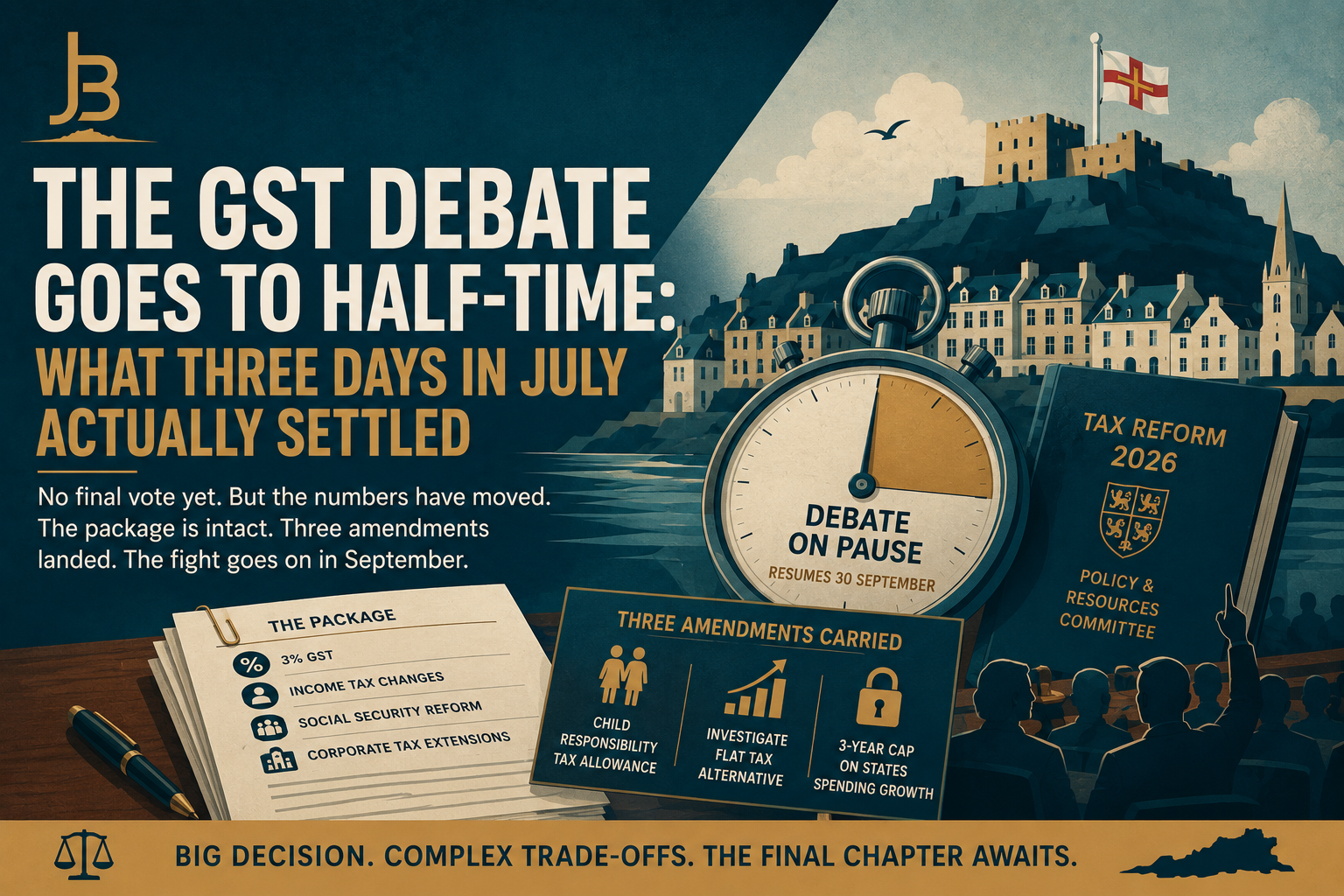
Guernsey’s biggest tax decision in a generation is now on a summer break. After three days of debate on 15–17 July, the States ran out of road before reaching a final vote on Policy & Resources’ tax reform package — the 3% GST, the accompanying income tax and social security changes, and the corporate tax extensions attached to it. Deputies will pick it back up on 30 September.
That pause is worth reflecting on. Nothing has been decided, but a lot has already happened, and the shape of what’s left to debate has changed in ways that matter more than the headline “no vote yet” suggests.
What was actually on the table
P&R’s package, published in June, centres on a 3% GST alongside higher income tax allowances, a reformed lower income tax band, and modest extensions to corporate tax — including bringing the 10% rate to cover the full profits of regulated businesses. Taken together, the committee says the package raises about £42m a year gross, or roughly £39.5m net once running costs are stripped out. That is the number to hold onto, because most of what follows is a fight over how that £39.5m gets found and who carries it.
The kill shots that didn’t land
Three attempts to stop the package outright were all defeated in the first two days:
- A sursis from Deputy Liam McKenna and Deputy Mark Helyar to delay the whole debate, pending a new States Treasurer’s advice and a clear-out of the Revenue Service’s backlog, fell narrowly, 17 votes to 22.
- An amendment to drop GST from the package entirely (McKenna) was defeated more heavily, roughly 28 votes to 10.
- A call for a binding referendum on GST (McKenna and Simon Vermeulen) was rejected 25 votes to 14.
- A separate bid to scrap the package for a new Appropriations Committee tasked with finding savings first (Garry Collins and Haley Camp) lost 29 votes to 11.
P&R came out of those votes able to say, fairly, that its core proposition is intact. Treasury lead Charles Parkinson told the Press he believed there was “clearly a majority in favour” of the package; P&R President Lindsay de Sausmarez was more circumspect but agreed the numbers looked to be there. Neither claim has been tested – the substantive vote hasn’t happened, but the pattern of the July votes doesn’t contradict it.
What did land
Three amendments were carried, and each of them changes what P&R will actually be implementing if the package eventually passes:
- A Child Responsibility Tax Allowance (Andy Sloan and Munazza Malik) – a direction to P&R to introduce a new income tax allowance for each dependent child. This wasn’t a request for a report; it was an instruction. Gavin St Pier made the sharper point in debate: this is a directive, not a study, and the most likely funding source for it is more revenue – quite possibly more GST.
- An instruction to investigate a flat tax rate as an alternative structure.
- A three-year cap on growth in total States expenditure, including social security spending, to inflation (Sloan, moved by Helyar in his absence), which passed by the narrowest margin of the sitting, 15 votes to 12.
The spending cap is the one worth watching. It was framed as a discipline measure, but its scope, explicit inclusion of social security spending, not just departmental budgets, has already drawn a public warning from the Committee for Health & Social Care that it risks real-terms cuts to services, and Bailiwick Express has since run a fact-check on the more alarmist claims doing the rounds about pensions being at risk (their verdict: the amendment doesn’t force pension cuts, but it does tie ESS’s hands in a way that could force difficult trade-offs). This is exactly the kind of measure that sounds costless in a sound bite and isn’t: capping headline spending growth to inflation while service demand, health and care in particular, runs ahead of inflation is a structural squeeze, not a saving.
There’s a genuine tension buried in July’s results that P&R will have to reconcile before September: deputies voted, in the same sitting, to add a new tax allowance (a cost) and to cap spending growth (a constraint on where new costs get absorbed). Both carried. Neither amendment’s proposers were required to reconcile them with each other, and it’s not obvious P&R’s £39.5m net figure survives both being implemented as instructed.
The procedural oddity
Under the Assembly’s normal rules, adjourned debates don’t reopen for new amendments. Officials have indicated they’ll take a different view here, effectively reopening the amendment window until 22 September – which all but guarantees the 22 amendments considered in July will be added to before the Assembly reconvenes. Deputies campaigning against GST, including Garry Collins, have already signalled they’re preparing further amendments over the recess.
Reading the numbers
The vote margins across July tell a story in themselves. The sursis and the flat “no GST” amendment both lost by comfortable double-digit margins – this is not an Assembly on the verge of rejecting reform outright, in the way it did in 2023. But the spending cap amendment passing 15–12 is a different kind of signal: on a genuinely contested, ideologically loaded question about the size and shape of government, the numbers are close enough that a handful of switched votes moves outcomes. If the substantive GST vote in September comes down to a margin like that, this is not settled business, whatever the confidence from Treasury and P&R leadership suggests.
What to watch for in September
- Whether P&R chooses to adjust its own package before the debate resumes, as de Sausmarez has hinted is possible, rather than defend it unamended against a fresh round of amendments.
- How P&R proposes to reconcile the child tax allowance and the spending cap, both now carried, both pulling in opposite directions on the same £39.5m.
- Whether the reopened amendment window produces anything that changes the arithmetic, rather than simply adding volume to an already long list.
- The roughly ten to eleven amendments left over from July that still haven’t been debated at all.
None of this changes the structural point that’s been the throughline of this year’s tax debate: Guernsey has a funding gap that isn’t going away, reserves that are being run down to cover it, and a package on the table that raises real revenue but does so by reshaping who pays and how. Three days in July didn’t answer whether the States will accept that reshaping. It mostly confirmed that the fight over the details, allowances, caps, who bears the transition, may end up mattering as much as the headline GST number itself.
Sources: Guernsey Parliament (parliament.gg), States Meeting 15 July 2026, Billet d’État XII; Guernsey Press, 15–22 July 2026 and 17 August 2026; Bailiwick Express, July 2026; States of Guernsey, “2026 Tax Reform Package published.”
Jon Bond is Founder and CEO of Evans Bond Limited, an accountancy and advisory practice in Guernsey, and principal of Melius Consulting Limited – a business consultancy. He is also a non-executive chairman of CI Co-op and Sark Shipping. The views expressed here are his own.

