Jon Bond

Small Island, Big Ideas


Category: Economy

  • Jersey Voted. What Did It Say?

    Jersey Voted. What Did It Say?

    The results are in from Sunday’s Jersey election and they contain some genuine surprises, a political giant lost his seat, an outsider topped the poll, Ihe hospital contract was finally signed, and the case for party politics just got harder to make. Here’s what it means, viewed from across the water.

    In my pre-election post last week I said Jersey’s 2026 election would be a test of whether the electorate wanted something genuinely different, or whether familiarity and experience would win out over fresh voices. As it turns out, it was a bit of both, but the headline story is the one nobody predicted: Reform Jersey’s leader Sam Mézec, the serving Housing Minister and arguably the most prominent progressive voice in island politics, has lost his seat.

    That is not a small thing. Let’s work through what happened, what the results mean, and what signals, if any, they send to the new States Assembly.

    The Results at a Glance

    15,859VOTES FOR TOP SENATOR HELEN MILES

    9,374MÉZEC VOTES — 2,197 SHORT OF 9TH PLACE

    £710mHOSPITAL CONTRACT SIGNED 2 DAYS BEFORE ELECTION

    18AGE OF YOUNGEST ELECTED MEMBER, GABRIEL RAIMONDO

    The Senatorial Ballot — Full Results

    Jersey voters cast island-wide votes for nine Senators. With 17 candidates standing, the margin between those who made it and those who didn’t tells its own story.

    Senatorial Votes

    Five Things the Results Tell Us

    1. Experience, broadly defined, won the Senate

    Look at the nine elected Senators and a pattern emerges. Helen Miles topped the poll with nearly 16,000 votes – a remarkable result for someone who, four years ago, was a first-time Deputy for St Brelade. But her result reflects experience of a certain kind: 30 years in public service, a high-profile ministerial term, and then a credible stint as opposition scrutineer when the government changed direction. She wasn’t the establishment candidate. She was the candidate who’d seen both sides of government and handled both well.

    Ian Gorst comes second – the most internationally experienced politician in Jersey, and someone whose vote share in the rural parishes was consistently the highest throughout the night. Lyndon Farnham third, the sitting Chief Minister, seeking his mandate. Elaine Millar fourth, the Treasury Minister who made reinstating Senators her signature achievement.

    What this Senate looks like is a broadly centrist, experience-heavy chamber with a bias towards fiscal discipline and financial services credibility. The two notable exceptions: Mary Le Hegarat (9th, first-time Senator) and Serena Kersten Guthrie (5th, entirely new to politics) are both significant in different ways.

    Elected Senators

    2. The Mézec defeat is seismic — but nuanced

    Sam Mézec received 9,374 votes. Mary Le Hegarat, who took the ninth and final seat, received 11,571. That gap of 2,197 votes, across an island-wide ballot, is not a cliff edge – it’s a margin that could have closed with the St Helier results, but did not.

    Mézec has been the most prominent voice for social democratic politics in Jersey for over a decade. As Minister for Housing in the current term, he secured the ‘First Step’ homeownership scheme, new renter protections, and hundreds of new homes. His legislative record is real. The fact that the island-wide electorate chose not to send him to the Senate – while St Helier, where Reform Jersey is strongest, voted for him in large numbers – suggests something specific: his appeal is urban and concentrated, not island-wide.

    There is a harder question lurking here too. Reform Jersey now has 7 seats, down from ten in the last Assembly. Mézec himself is out of the chamber entirely. That is not just a bad night. That is a party facing a structural question about whether its model – a left-leaning progressive party in a conservative-leaning island, is viable at scale.

    Reform Jersey – The Numbers

    In 2022, Reform Jersey held 10 seats in the States Assembly. As of the 2026 results, they are projected to hold between 3 and 5 seats, with St Helier counts still outstanding. Their leader has lost his seat. Their Education Minister (Rob Ward) lost his bid for Constable of St Helier. The party’s Deputy Leader Lyndsay Feltham’s result in St Helier Central is not yet confirmed. This is a significant reduction in their parliamentary presence.

    3. The Kersten Guthrie result is the one to watch

    Serena Kersten Guthrie, former England netball captain, political newcomer, and Value Jersey-aligned candidate, finished fifth – ahead of Tom Binet, Alan MacLean, Mark Boleat, and seven others, with 12,588 votes.

    In my pre-election analysis I flagged her as the most unusual candidate in the field. That unusual quality clearly resonated. What does it mean?

    Partly it’s biographical – a decorated athlete from a recognisable background brings a kind of credibility that professional politicians sometimes lack. Partly it’s the Value Jersey alignment – a loose grouping of candidates united around consumer choice, cheaper everyday costs, and cutting government waste. As parish results were being announced through the night she consistently came second or third.

    Watch this closely: Value Jersey as a movement, not quite a party, more than a leaning, performed well enough across the Deputy elections too (Samantha Gleave topped the poll in St Helier South). If that cohesion persists into the new Assembly, it could constitute a real force: centre-right consumer economics, independent-minded, with populist energy behind it.

    4. The hospital was signed just in time

    Two days before election day, the Government confirmed that the main works contract for the new hospital at Overdale had been signed with Bouygues UK. The project has a budget of £710 million, making it the largest public infrastructure project in Jersey’s history, with delivery targeted before the end of 2028.

    The timing was noted. Health Minister Tom Binet had warned in April that there was “no guarantee” the contract would be signed before the election. It was. Whether that influenced voters is impossible to say with certainty, but Binet finished sixth in the Senatorial poll – comfortably elected, with a vote share that reflects genuine public recognition of his work.

    The new Assembly inherits this project. It will be the defining test of delivery for the incoming government: a £710m construction programme, a contractor whose UK arm has had financial difficulties, and a completion target set in the middle of the next term. The new Senators who promised to hold government to account on delivery will have no shortage of material.

    The Hospital – Key Facts

    Budget: £710 million (States Assembly approved).

    Contractor:Bouygues UK (subsidiary of French construction giant Bouygues Construction — 400+ global healthcare projects).

    Target completion: Before end of 2028.

    Contract signed: 5 June 2026, two days before election day.

    Outgoing minister: Tom Binet, elected Senator — will not be Health Minister by default in new government.

    5. An 18-year-old was elected Deputy

    Gabriel Raimondo, 18 years old, was elected as a Deputy for St Brelade, becoming the youngest member of the States Assembly. He received 1,603 votes, in a constituency also electing experienced candidates Jonathan Renouf (who topped the poll with 2,414 votes) and Reform Jersey’s Monty Tadier.

    This is worth noting for reasons beyond the symbolism. Jersey has a voting age of 16. An 18-year-old Deputy is the logical extension of a political culture that takes youth participation seriously. Whether Raimondo proves effective is a question only time will answer, but his election sends a signal that constituency voters are willing to take a chance on someone whose principal qualification is that he is, himself, a young person with a stake in the decisions being made.

    What the New Assembly Looks Like

    The most significant question now is who becomes Chief Minister. Gorst has publicly said he will put himself forward for External Relations Minister again. Farnham has indicated he wants to continue as Chief Minister. But with Helen Miles topping the poll and Elaine Millar suggesting she would support Miles over competing against her, there is a genuine possibility of a female Chief Minister for the first time in Jersey’s history, if Miles chooses to put herself forward on 19 June.

    The Messages for the New Assembly

    Elections are often said to send messages. Jersey’s 2026 result sends several, and they are not all comfortable ones for the incoming government.

    01 Delivery is the Mandate

    The electorate returned experienced, recognisable politicians. Not radicals. That is a conservative choice — in the literal sense. It is a vote for getting things done, not for changing direction. The new government will be judged on what it delivers, not what it says.

    02 The Cost of Living Cannot Wait

    Value Jersey’s strong showing — from an outside newcomer no less — is a direct signal about affordability. Kersten Guthrie’s fifth place finish is a message: voters want cheaper choices, more competition, less government drag on everyday costs. The new Assembly ignores this at its peril.

    03 The Left have been Pushed to the Margins

    Reform Jersey’s collapse from ten seats to fewer than five is a fundamental shift. There is now very limited organised progressive representation in the Assembly. That may suit the new government; it makes meaningful scrutiny of housing and welfare policy harder.

    04 The Hospital must now be Built

    The contract is signed. The £710m is committed. Bouygues UK is on site. This is no longer a political football — it is a construction project with a deadline. The new Assembly must resist any temptation to relitigate decisions already made and focus on delivery.

    05 GST is on the Agenda

    Multiple losing candidates called for GST to be removed from food. The issue did not disappear; it simply wasn’t reflected in the Senate. A £710m hospital and infrastructure backlog means the fiscal question won’t go away. Jersey will need to have an honest conversation about how it pays for things.

    06 Youth and Diversity are Visible

    An 18-year-old Deputy. The first female Constable of St Helier. The island’s first Senator without a career political background in a generation. These are small steps, but they signal that the electorate is willing to widen the pool — when candidates make the case for themselves.

    The View From Guernsey — What This Means for Us

    I said in my pre-election post that Jersey’s issues are Guernsey’s issues. The results reinforce that. The centrist, experience-favouring outcome; the voter appetite for cost-of-living action; the grinding difficulty of delivering major infrastructure — none of that is peculiar to St Helier.

    There is one result in particular that I think Guernsey should sit with. Sam Mézec — whatever you think of his politics — was the most prominent champion of progressive social policy in the Channel Islands for twelve years. He championed tenant rights, minimum wage rises, housing supply, and public accountability. He has now lost his seat in an island-wide ballot. That is partly about electoral arithmetic. But it is also a reflection of a political culture that is instinctively wary of structural reform, and which tends, when uncertain, to return to the familiar.

    The question for Guernsey is not whether we share that instinct — we almost certainly do — but whether, when our own fiscal pressures force difficult decisions, we have the political infrastructure to navigate them well. An Assembly of independents, all elected on personal platforms, all instinctively cautious about being the one to say the uncomfortable thing, is not automatically well-equipped for that moment.

    Jersey has its new government. The hospital contract is signed. The Chief Minister question will be resolved on 19 June. Whatever happens next, Sunday’s result suggests that the island wants steady hands on the wheel — and will hold them to account for what those hands actually build.

    Jon Bond is Founder and CEO of Evans Bond Limited, an accountancy and advisory practice in Guernsey, and principal of Melius Consulting Limited – a business consultancy. He is also a non-executive chairman of CI Co-op and NED at Sark Shipping. The views expressed here are his own.

    The View From Guernsey — What This Means for Us

    I said in my pre-election post that Jersey’s issues are Guernsey’s issues. The results reinforce that: the centrist, experience-favouring outcome; the voter appetite for cost-of-living action; the grinding difficulty of delivering major infrastructure – none of which is peculiar to St Helier.

    There is one result in particular that I think Guernsey should take note of. Sam Mézec, whatever you think of his politics, was the most prominent champion of progressive social policy in the Channel Islands for twelve years. He championed tenant rights, minimum wage rises, housing supply, and public accountability. He has now lost his seat in an island-wide ballot. That is partly about electoral arithmetic. But it is also a reflection of a political culture that is instinctively wary of structural reform, and which tends, when uncertain, to return to the familiar.

    The question for Guernsey is not whether we share that instinct, we almost certainly do, but whether, when our own fiscal pressures force difficult decisions, we have the political infrastructure to navigate them well. An Assembly of independents, all elected on personal platforms, all instinctively cautious about being the one to say the uncomfortable thing, is not automatically well-equipped for that moment.

    Jersey has its new government. The hospital contract is signed. The Chief Minister question will be resolved on 19 June. Whatever happens next, Sunday’s result suggests that the island wants steady hands on the wheel, and will hold them to account for what those hands actually build.

    Jon Bond is Founder and CEO of Evans Bond Limited, an accountancy and advisory practice in Guernsey, and principal of Melius Consulting Limited – a business consultancy. He is also a non-executive chairman of CI Co-op and NED at Sark Shipping. The views expressed here are his own.

  • Guernsey’s 2025 Accounts: The Headline Looks Good, The Small Print Is More Complicated.

    Guernsey’s 2025 Accounts: The Headline Looks Good, The Small Print Is More Complicated.

    The States of Guernsey has just released its consolidated financial statements for 2025 and the headline figure will catch your eye: a reported net surplus of £106 million.

    After years of discussion about a structural deficit and the need for fundamental tax reform, that sounds like good news. But read past the headline, and a more nuanced picture emerges – one that has significant implications for every business and resident on the island.

    What the Accounts Actually Show

    The States of Guernsey Consolidated Accounts (including the States itself, plus entities like Guernsey Water, Guernsey Electricity, Guernsey Ports, Guernsey Post, Aurigny etc.) reported:

    • Total revenue: £1.25 billion (up 14.4% from £1.09 billion in 2024);
      • Tax and social security made up £881 million
    • Total expenditure: £1.18 billion (up 6.3% from £1.11 billion in 2024);
    • Net surplus: £106.1 million (compared to a surplus of £20.3 million in 2024);
    • Net assets: £4.08 billion (up from £3.92 billion in 2024);
    • Total debt: £403.5 million.

    On the face of it, the improvement is dramatic — an £86 million swing in one year.

    Why the Treasurer Is Urging Caution

    Here is where it gets interesting. The States Treasurer’s own report, published alongside the accounts, is notably careful about what the surplus actually means.

    The £106 million net surplus figure includes £118.9 million in unrealised investment gains on the States’ £1.73 billion investment portfolio that have not been realised. Strip those out and the underlying operating position is actually in deficit.

    The Treasurer’s report goes further: “With one-off items and unrealised investment valuation excluded and after adjusting for the long-term capital investment requirement (2% of GDP), the underlying financial position of the group had a funding gap to close of some £50 million in 2025.”1

    In other words, the States’ own assessment is that on a sustainable, recurring basis, Guernsey is still spending around £50 million more per year than it earns.

    The One-Off Items That Won’t Come Back

    Two specific items inflated the 2025 figures and are explicitly flagged as non-recurring:

    • £39 million from Pillar 2 tax. Guernsey implemented the OECD’s global minimum tax on the profits of large multinational companies in 2025. The first year produced £39 million of accrued income, but critically, a significant portion of this has been recognised in the accounts now but will not be collected until mid-2027. The cash hasn’t arrived yet, and it is a new revenue stream whose future (and 2025) yield remains uncertain.
    • £34 million in one-off corporate tax receipts. These relate to banking sector tax adjustments from prior years. The Treasurer’s report is explicit: these are not expected to recur in future years.

    Together, those two items account for £73 million of the reported surplus. Without them, and without the unrealised investment gains, the position would look very different indeed. As tax expert Mike Williams has noted publicly, without Pillar 2, the structural deficit would have exceeded £100 million.2

    Despite a £106m Surplus, Cash Fell by £9 Million

    One of the most striking single facts in the accounts is this: despite the reported £106 million surplus, the States’ cash balances actually fell by £9 million during the year.

    How? Because £113 million was invested in infrastructure, assets and major projects during 2025 – capital spending on roads, water, power, ports and other long-term assets. The Group’s cash position moved from a net positive of £4.9 million at the start of the year to a net negative position of £4.4 million by year-end.

    This is a useful reminder that a surplus in the income statement does not automatically mean more cash in the bank.

    The Investment Portfolio: Good Returns, Below Target

    The States’ General Investment Portfolio, which was worth approximately £1.73 billion, delivered a return of 7.2% in 2025. That is a solid return by most measures, and it generated £118.9 million in unrealised gains that flow into the headline surplus figure.

    However, the portfolio’s target return is 8.5%, and its policy benchmark is 9.1%, so performance came in below both benchmarks. The portfolio also paid out £122.5 million during the year to fund capital investment and other commitments, keeping the overall value broadly flat year-on-year.

    The Pension Position Improved Significantly

    One piece of genuinely good news in the accounts is the pension position. The Group’s defined benefit pension liability of £44 million in 2024 has swung to a £6.1 million asset in 2025, a £50.1 million improvement. This is driven by changes in actuarial assumptions and investment performance, and it reduces a long-term financial risk that had been building for several years.

    The Bigger Picture: A Structural Problem That Has Not Gone Away

    The 2026 Budget, published before these accounts, already acknowledged a structural deficit of £77 million that will persist until fundamental tax reform is implemented. The 2025 accounts do not change that assessment, if anything, they illustrate exactly how fragile the revenue base is.

    Deputy Gavin St Pier, the former P&R Committee’s treasury lead, has previously pointed to a fundamental vulnerability: approximately 75% of Guernsey’s public revenues come from personal income tax and social security contributions from the working-age population. That is an unusually narrow base for a government of this scale, and one that is vulnerable to demographic change, economic slowdown, or any shift in the financial services sector.

    What About the GST Debate?

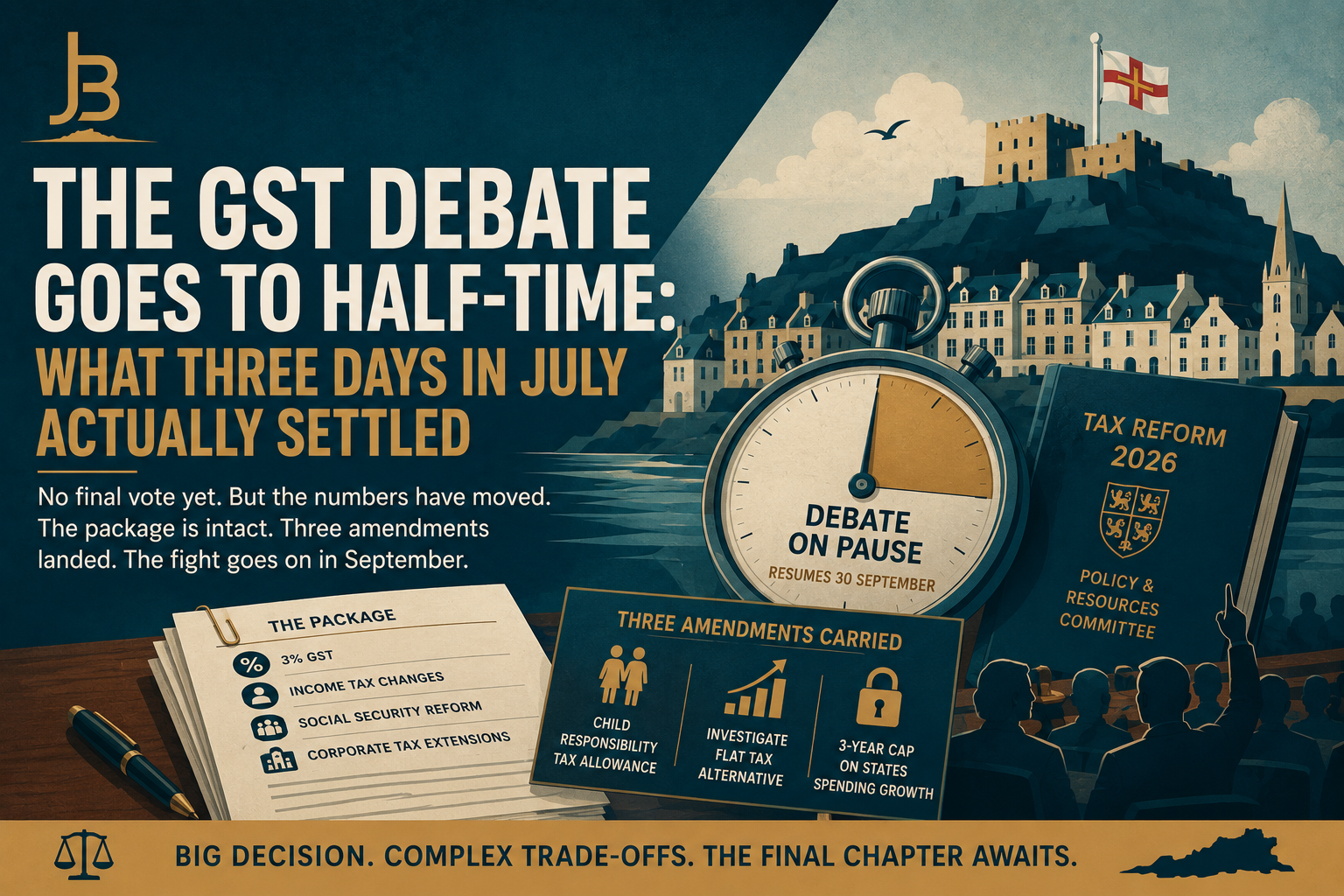
    Our previous blog post about GST highlights the complexities of GST, but even since then the landscape has shifted. These accounts create the real risk that any tax reform will again be kicked down the road by the States Assembly.

    The tax reform picture has shifted since the Budget. The GST-plus package of a 5% goods and services tax combined with income tax cuts to 15% had been the expected solution. However, as of late May 2026, Guernsey Press is reporting that four of the five senior P&R Committee members oppose GST-plus and the committee is now developing an alternative plan.

    The final proposals are expected in a policy letter on 8 June, with a States debate in July. Whatever the outcome, fundamental change to Guernsey’s tax system is now a matter of when, not if. The numbers in these accounts make that clear.

    What Does This Mean for You?

    For businesses and individuals in Guernsey, the 2025 accounts are a useful prompt to consider a few things:

    Tax change is coming. Whether it is GST, higher income tax, extended corporate tax rates, or some combination, the fiscal reality documented in these accounts makes reform inevitable (even if delayed). Planning ahead, understanding your personal and business exposure to likely scenarios, is worth doing now, before the States makes its decision in July.

    Corporate tax rates may change. The possibility of extending the 10% intermediate corporate income tax rate to GFSC-regulated professional services firms is still in play. If you run a regulated business, this could affect your tax position from 2027 or 2028.

    Capital investment is continuing. The States spent £113 million on infrastructure in 2025. That spending supports the local economy, but it also means ongoing capital requirements will keep pressure on the public finances regardless of what happens with the revenue side.

    The Pillar 2 income is not guaranteed. The £39 million recognised in 2025 will not be collected until mid-2027, and the long-term yield of this new tax on multinational profits is inherently uncertain. It should not be counted as stable, recurring income.

    Talk to me

    The next six months will be defining for Guernsey’s fiscal future. Whether you are a business owner thinking through the implications of tax reform, an individual planning your finances ahead of possible changes, or a regulated firm concerned about corporate tax rate changes, my Accounting firm Evans Bond can help you understand your position and plan accordingly.

    Visit our website for more info.

    Jon Bond is Founder and CEO of Evans Bond Limited, an accountancy and advisory practice in Guernsey, and principal of Melius Consulting Limited – a business consultancy. He is also a non-executive chairman of CI Co-op and NED at Sark Shipping. The views expressed here are his own.

    1. States of Guernsey Accounts 2026 ↩︎
    2. Guernsey Press 20th May 2026 ↩︎

  • The Island Economy in 2026: Five Signals I’m Watching

    The Island Economy in 2026: Five Signals I’m Watching

    Introduction

    Coming up to the halfway mark of 2026, and the Channel Islands economy continues to resist easy characterisation. The headline numbers look stable. The texture underneath is more interesting and, in some places, more concerning, than the broad brush suggests.

    I’ve been involved in leading financial services businesses in Guernsey for over 15 years, and sitting on the boards of CI Co-op and Sark Shipping gives me a vantage point that I think is worth sharing.

    These are not forecasts. They’re observations from someone paying close attention.

    Signal 1: Supply Chains are Fragile

    The narrative that post-pandemic supply chain disruption is “fixed” doesn’t hold up in a small island context. Lead times to the Channel Islands for specialist supplies remain longer and less predictable than they were in 2019.

    Businesses that have adapted — by carrying more stock, diversifying suppliers, or redesigning their service offerings are noticeably more resilient. Those who assumed a return to pre-2020 norms are still being caught out. The lesson here isn’t specific to islands. But islands make the lesson visible faster.

    Signal 2: The Talent Pipeline is Narrowing

    Finding mid-level professional talent in Guernsey has become materially harder in the past 18 months. This is partly demographic, a smaller cohort moving through the local pipeline, and partly the result of increased competition from remote-work opportunities that didn’t exist five years ago.

    The best people have more options. That’s good for them and requires genuine creative thinking from employers who want to attract and keep them. Retention strategies that worked in 2019 – stability, island lifestyle, modest salary premium, need updating.

    Signal 3: Consumer Behaviour has Shifted Permanently

    The “island premium” – the willingness of local consumers to pay more for local goods and services because of limited alternatives, is being eroded by e-commerce and changing expectations. This isn’t a crisis, but it is a structural shift. Businesses whose pricing assumed a captive local market should be modelling different scenarios.

    Signal 4: Digital Adoption is Uneven

    Some Guernsey businesses have accelerated their digital capability significantly over the past three years. Others have barely moved. The gap between these two groups is now visible in trading performance, client acquisition, and staff expectations.

    This is not primarily a technology problem. It’s a leadership problem. The businesses falling behind are almost always led by people who view digital investment as a cost rather than a capability.

    Signal 5: Community Institutions are the Overlooked Infrastructure

    Local charities and faith organisations don’t appear in economic forecasts. They should. These institutions provide social and operational infrastructure that a small island economy could not replace. Their resilience is a precondition for everything else.

    Business leaders who don’t engage with and support these organisations are, whether they know it or not, free-riding on a system they’re not contributing to.

    Conclusion

    None of these signals is cause for alarm. But together they describe an economy that needs proactive leadership from business owners, board members, and community institutions to navigate well.

    I’ll be writing about each of these in more detail over the coming months. If you have a perspective from your own sector, I’d genuinely like to hear from you.

    Jon Bond is Founder and CEO of Evans Bond Limited, an accountancy and advisory practice in Guernsey, and principal of Melius Consulting Limited – a business consultancy. He is also a non-executive chairman of CI Co-op and NED at Sark Shipping. The views expressed here are his own.